
Go Setups & Go Fast
Pro setups plus the Go Fast telemetry app. Race engineer in your pocket.
Go Setups & Go Fast discount codeGo Setups, my honest take
Simracing Psychology
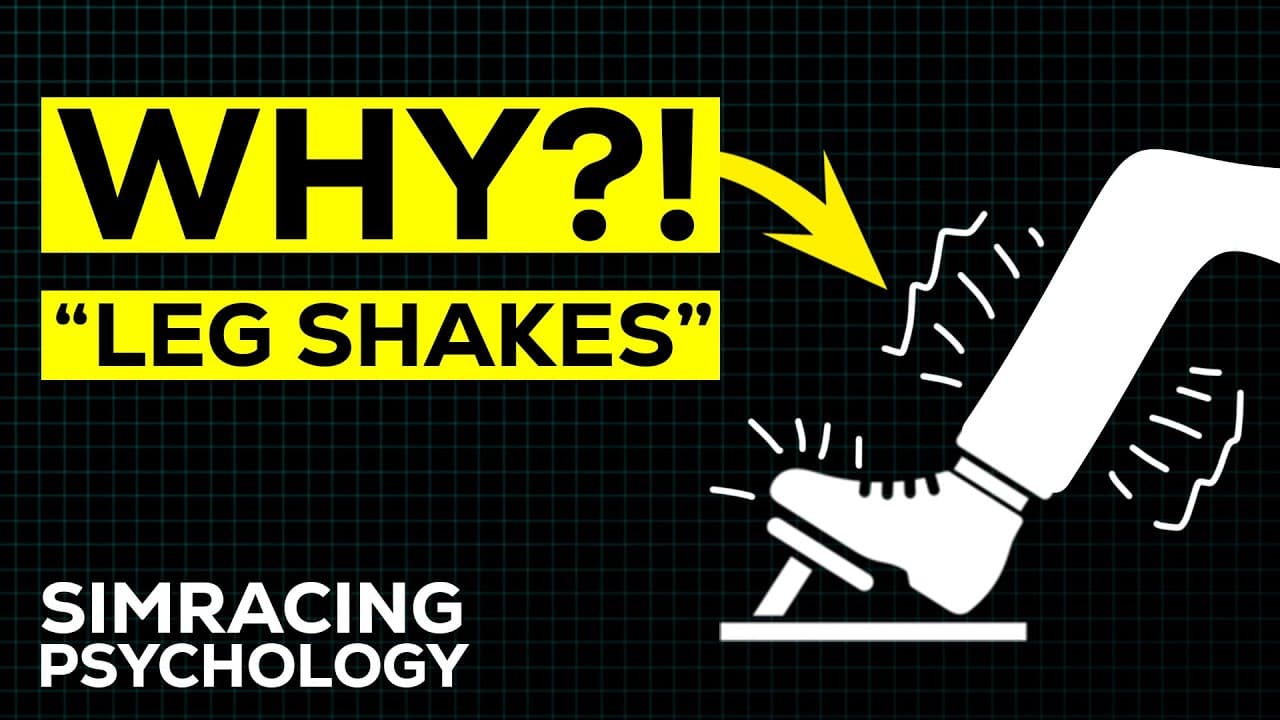
Pressure's sky high, podium's on the line, and your right leg starts shaking so hard you can barely modulate the brakes. It's not just you. It's a real, named, studied physiological response. Here's what's actually happening, why it's a good sign, and the four steps to channel it instead of fight it.
Start here
Last lap of a race you actually care about. Podium in reach. Your right leg starts juddering on the brake pedal so hard you can barely modulate it. Throttle feels jittery. You miss your braking point by a metre. Then you notice the shaking, you start watching the shaking, and it gets worse.
Every simracer I've spoken to about this knows exactly the feeling. I lived with it for the best part of six months when I first got onto iRacing. It's a real thing, it has a name, and it's fixable.
Honest framing before we get into it. I'm a simracer who studied a bit of psychotherapy. This isn't a lecture, it's me mashing the two things together so we get a little faster and have a bit more fun doing it.
Recognise yourself
If any of those land, you're in the right article.
The science bit
What you're feeling is called somatic anxiety, the physical side of performance anxiety. The chain of events is the same one your nervous system has been running for two hundred thousand years. The problem is the context.
When the pressure spikes, your sympathetic nervous system flips into fight or flight. Heart rate jumps, breathing gets shallow, adrenaline floods your muscles. Brilliant if a sabretooth tiger has rounded the corner. Less brilliant if you're defending P3 into the bus stop.
In real motorsport, that adrenaline gets burned. Arms fight the wheel, neck fights the G, core braces against the seat. The energy has somewhere to go.
In simracing, your body thinks it's in a fight, but you're strapped to an aluminium frame trying very hard not to move. The energy has nowhere to go. It leaks out as a tremor, usually in the leg that's holding pedal pressure under tension.
That's the whole mechanism. A real fight-or-flight response with the physical outlet surgically removed.
Same chemistry, different outlet
Why it costs you
It isn't the shaking itself that gets you. It's what the shaking does to the inputs and to your attention.
01
Micro variations in pedal pressure
The leg can't hold a steady force. Brake bias shifts mid-corner, ABS chatters, the car becomes unpredictable.
02
Drifting braking points
You blow past your actual marker by a metre or two each lap. Each lap becomes a slightly different lap, the rhythm breaks.
03
Jittery throttle on exit
You can't get clean traction off the corner. Rears step out, lap time bleeds away on every straight.
04
Attention hijack
The second you notice the shaking, your attention shifts to it. Less of your brain on the track, more of your brain on the symptom, and the symptom gets worse.
Reframe
Don't beat yourself up about it. Your body is trying to tell you something useful.
A shaking leg means this matters. That adrenaline spike is your body confirming you're fully invested in the outcome, that you're taking it seriously. Sports psychology has a word for it, and the word is activation. Activation is the fuel that lets you perform at your peak.
The goal isn't to make this feeling go away completely. The goal is to channel it. To learn to drive with the dial turned up, instead of being hijacked by it.
I had it bad on iRacing for about six months. I've mostly worked through it, but it can still come back when I'm pushing into new territory. Recently I was running P5 in a properly competitive split, on the last lap, and I noticed it happening again.
It was a thrill. I was right at my limit, chasing something I really wanted, and that feeling is worth enjoying.
I finished the race with my hands still shaking a little. Under pressure, getting everything out of myself, having fun. That's the relationship you want with it.
The long game
Here's the good news. For most simracers, the shaking quietly disappears after enough exposure to high-pressure racing. Your brain learns that the adrenaline and the pressure aren't a real threat. The psychological term is habituation.
The more you put yourself into high-pressure situations, the more your nervous system recalibrates. What used to be a fight-or-flight trigger becomes your “ready to perform” state. Same chemistry, completely different relationship with it.
That's why rookies often struggle with leg shaking while experienced racers can drop straight into a top split and barely notice the pressure on their bodies.
One way I look at it now. Whatever happens in the race is going to happen. I know the job I need to do. I know the marks I want to hit. There's no need for my body to flip into fight or flight. If it does, it does. I work with it. I don't fight it.
How habituation works
First exposure
Body interprets pressure as threat. Full fight or flight. Shaking is loud.
Repeated exposure
Same chemistry, same conditions, no actual danger. Nervous system starts learning.
Recalibrated
Same trigger now interpreted as 'ready to perform'. Activation without the tremor.
Same nervous system. Same trigger. Completely different relationship with it.
The fix
The first three help right now, mid-race. The fourth is what makes the problem go away for good. They work because they attack both ends of the chain. Burn off the adrenaline physically, redirect your focus mentally, and over time rewire the response so the tremor never starts in the first place.
When the shaking starts, find a straight where you aren't braking and lift your foot fully off the pedal for half a second. On a long straight, flex the leg out and let it drop back to its natural position while you keep your eyes on the track.
Why it works
Gives the adrenaline a quick physical outlet. The tension that was building has somewhere to go.
Inhale through the nose for 4 seconds, hold for 2, exhale through the mouth for 6. Two or three rounds is enough. Do it on a straight, not into a corner.
Why it works
Adrenaline makes your breathing shallow, shallow breathing tightens muscles. Long exhales drop heart rate and loosen the legs almost instantly.
Stop monitoring the shaking. Lock your attention on the next braking marker, the next apex, the kerb you want to clip on exit. Specific, external, visible.
Why it works
Your brain can't fully focus on two things at once. Naming the thing you're looking at pulls processing power away from the tremor and gives it back to the lap.
Run practice races where you intentionally put yourself in high-pressure spots. Qualify near the front. Defend a position you don't really need. Race people who are clearly faster than you. Do it often.
Why it works
Controlled exposure is how the nervous system rewires this response for good. Your body learns the pressure isn't a threat, and stops overreacting in the first place.
A trick that worked for me
When I was racing in rookies and chasing my first win, the last lap used to wreck me. Tension building, leg shaking, brain already living in the moment I'd cross the line.
So I started lying to myself, very deliberately. As I crossed the line to start the last lap, I told myself “don't worry Jack, three more laps to go.”
My body calmed down. When I came round to the last corner of the race, my brain wasn't thinking “this is the last corner”, it was thinking “just another corner, three more laps to go.” The tension that usually clicks like a kettle about to boil never quite got there.
The second I crossed the line, I let myself feel everything. By then it didn't matter. The line was already behind me.
Use whatever little trick works for you. Exposure gets rid of this for good in the end, but tricks like this buy you wins in the meantime.
The lie I tell on the last lap
Without the trick
“Last lap. Don't mess it up. Last lap. Last corner. Don't mess it up.”
With the trick
“Three more laps to go. Just hit the marks. Three more laps.”
By the time the body realises the lie, you've already crossed the line.
The recap
A short version, in case you need to come back here mid-season and just glance.
The shaking is real, it has a name, and it's a sign that this matters to you. The four steps physically burn off the adrenaline, redirect your focus, and over time train your nervous system to stop overreacting in the first place.
Learn to control the response and you'll stay smooth under pressure no matter the stakes. Or you keep a bit of the shake, learn to enjoy it as the price of caring, and let it tell you you're getting everything out of yourself.
Both are valid. Both are far better than fighting it.
A note on Simracing Psychology
Somatic anxiety is one pattern. There are plenty more. Why overthinking makes you slow. The pro vision secret nobody talks about. The lie every simracer believes about iRating. All trainable, all very human, all documented over on the Simracing Psychology page.
The series is where I put the long versions of every one of these threads, videos and articles both.
Your body isn't broken. It's just overpreparing for a fight that isn't coming.
Activation is the fuel that lets you perform at your peak. Don't aim to kill it. Aim to channel it.
Keep going
Everything below is something I've made, used, or written. Affiliate links are marked the same way they are everywhere else on the site.
Related guides
Simracing Psychology
The flagship page. Manifesto, videos, articles. Where the rest of this thinking lives.
ReadThe Lie Every Simracer Believes
The arrival fallacy, the iRating chase, and why the satisfaction you're waiting for never quite arrives.
ReadThe Quiet Eye in Simracing
Where the pros look, why it steadies the hands, and how to train it into your own laps.
ReadGear that matters here
Pro setups plus the Go Fast telemetry app. Race engineer in your pocket.
Go Setups & Go Fast discount codeGo Setups, my honest take
Based out of Drift Games HQ in Ireland. Consultation, planning, building and setup of advanced simracing rigs for private and commercial clients.

The SIMAGIC starter bundle deal. Direct-drive base, wheel and pedals, a permanent $599.
SIMAGIC discount codeThe SIMAGIC lineup, explained
From the GT1 EVO to motion-ready P1-X frames, Sim-Lab kit handles whatever a direct-drive base throws at it.
Sim-Lab discount codeThe Sim-Lab rig I race onWatch the video version
All videos on YouTubeWhy Your Leg Shakes in High Pressure Races
The Simracing Psychology video this article was built from.
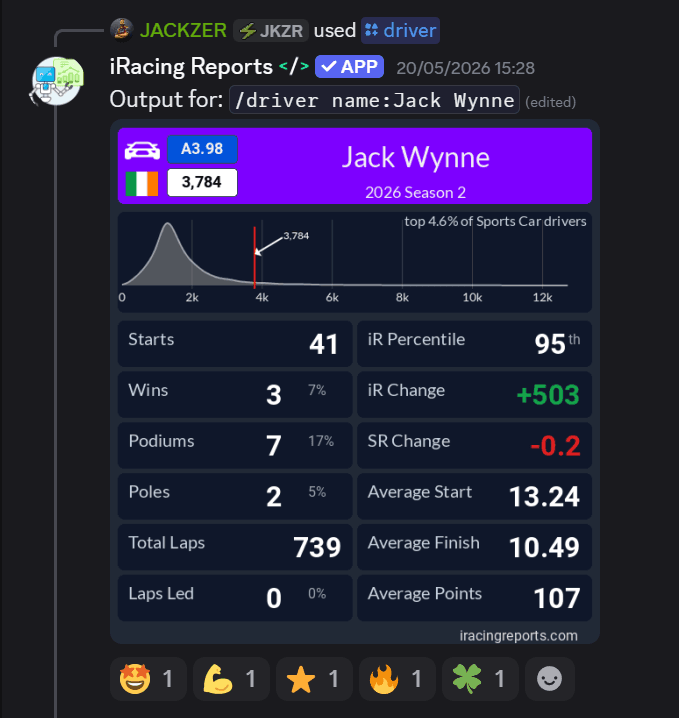
The Irish Pub would love to have you, we have league races on Thursdays and the craic is mighty. Can't wait to see you there.

Written by
Irish simracing content creator and SIMAGIC ambassador
I'm Jack. I race, I make videos about it, and I've spent years in the simracing community watching the hardware market grow up around it. Before any of this I was an electrician, so I've always been a tinkerer. I like taking a product apart in my head and asking how it could look better, work better, or just make more sense.
I also studied psychotherapy, which helps me understand what's going on in my own head when I drive, and sometimes helps me explain it in a way that's useful to you too.
Published
Channel partners